
Two Mirrors – KODE®
Competence Profile with 1:1 Debrief
This is for people 45+ asking a hard question about their work:
What am I actually good at ... and how much of it is going unused?
This is not...
-
A personality test that tells you who you are.
-
Another analysis to hide behind.
-
A report you read alone and file away.
No verdict. Just two honest views of the same person.
How it works
- You see yourself one way.
- Someone who knows you sees you another. (This can be anyone who sees you in action today: a colleague, a client, a business partner, or the person you share your life with.)
- KODE® shows both under normal conditions and under pressure.
Where they match, you gain confirmation. Where they don't, the real conversation begins.
30 years as a management consultant. Licensed KODE® practitioner. Professional training in systemic work. And I work with what I sense as much as with what I analyze. It took me decades to stop apologizing for that.
I don’t read your report back to you. I name what I see, even when it’s uncomfortable.
Knowing more won't make it clear.
Seeing what's already there will.
Angélique Morio
What you receive
A focused process of about five to six weeks, from your first questionnaire to our last conversation.
- Two KODE® profiles: your self-assessment and one external assessment, each with a full report in English or German.
- One deep debrief session via video call, up to two and a half hours. We put both profiles side by side and look at what's really there.
- Development recommendations for the one or two competencies worth deepening for you right now, and how to work on them.
- One follow-up session of 60 minutes, two to three weeks later, when what you've heard has had time to land.
Both conversations are recorded and yours to download, so you don’t have to take notes while we talk.
Two pages from my own report
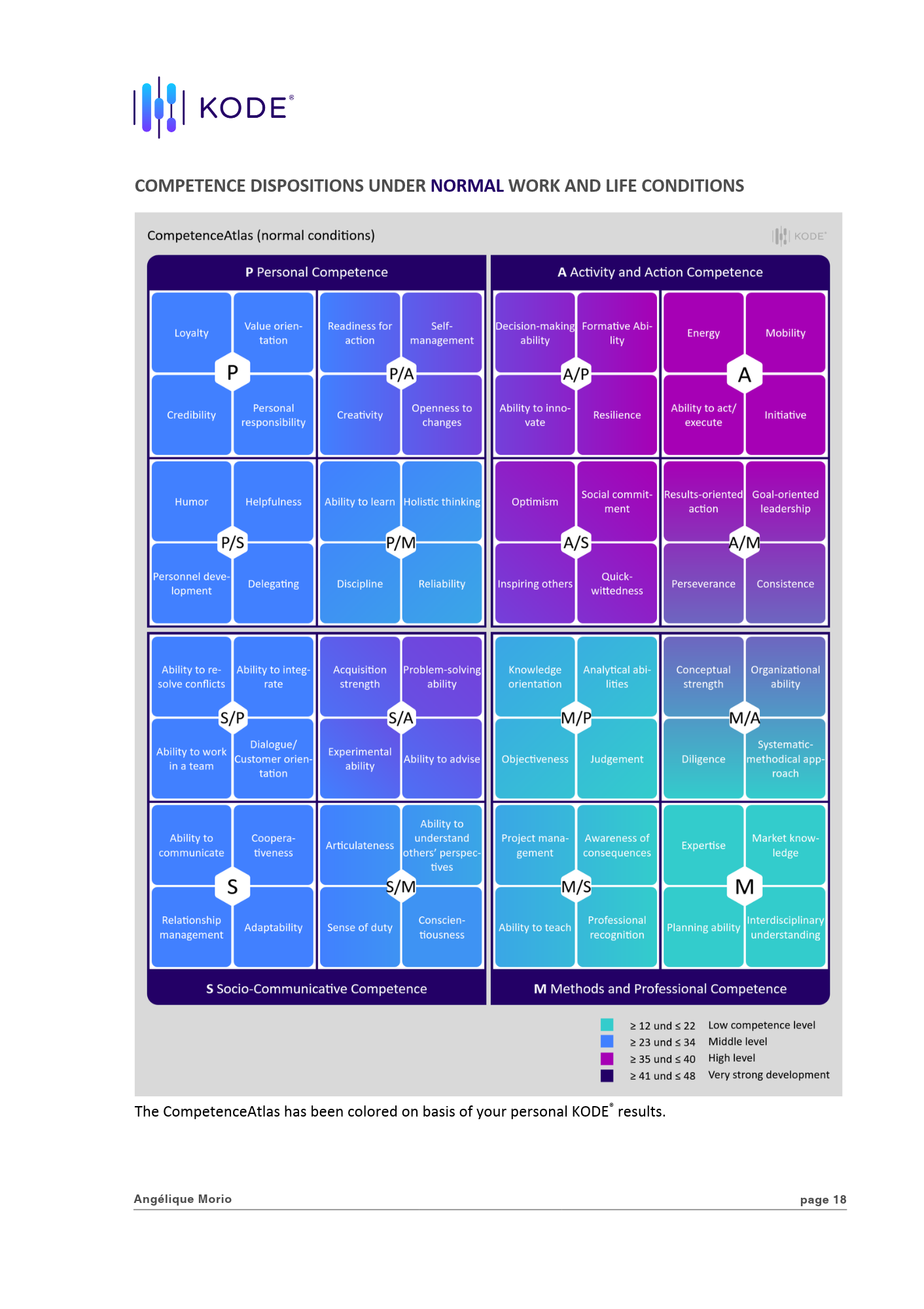
Under normal work and life conditions
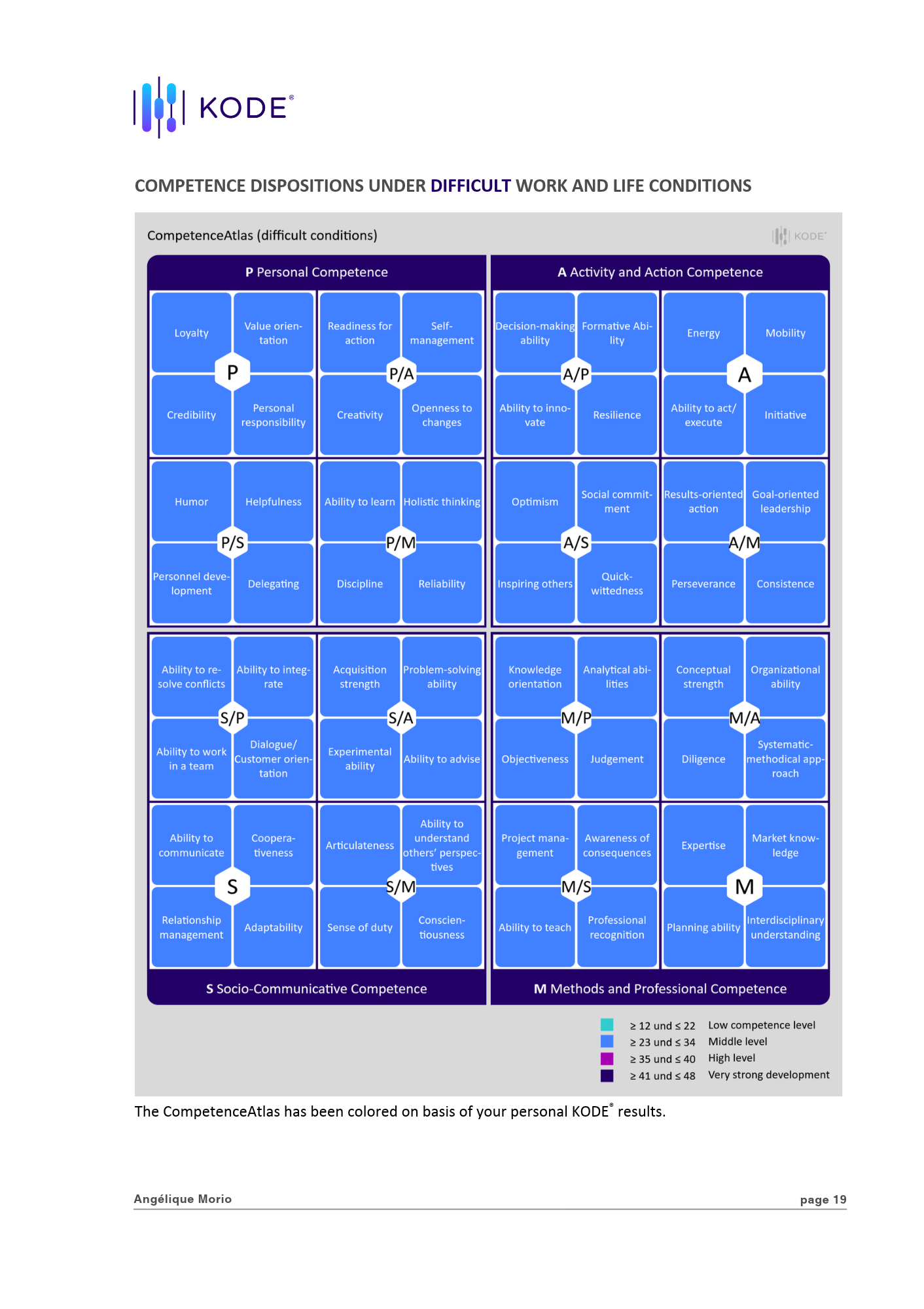
Under difficult work and life conditions
I did my first KODE® profile in 2011 and several more since.
Same pattern every time. It took me years to see it.
Your investment
$1,350 for the complete process.
incl. VAT where applicable, for private clients.
Two mirrors, two conversations, and 30 years of reading people, focused entirely on you.

Competent, cordial, clear. She was able to say things about me that applied 100% to me.
Your employer can also cover this. For companies, the price is net, plus VAT where applicable, and the invoice goes to the company.
The work stays yours: no reporting, no agenda but your own, and what we talk about stays between us.
Before you start
What is KODE®, in plain words?
A validated questionnaire that shows how you actually act in four areas: toward yourself, in getting things moving, with facts and methods, and with other people. Two German competence researchers, Volker Heyse and John Erpenbeck, developed it in the late 1990s. Since then it has been refined through more than 25 years of use, including by Germany's Federal Employment Agency and its pension insurance. Here it's used for one person: you.
Is this another personality test?
No. Personality tests describe traits you supposedly carry for life. KODE® measures competencies, meaning what you do when it counts. Competencies grow, shift, and fade when you stop using them. If you've ever read a test result, thought "yes, that's me," and then didn't know what to do with it, this is the part that comes next.
How does it work in practice?
You get a link by email and fill in the questionnaire online, which takes about 20 minutes. Your external person gets their own link and does the same. The whole process, from the first questionnaire to the last conversation, takes about five to six weeks. We have a debrief by video call of up to two and a half hours, and a 60-minute follow-up two to three weeks later. Both are recorded, so you can listen instead of taking notes.
What if I don't like what I see?
We look at it together. The results are a mirror. Every strength carries a weakness when it's overdone, and every gap is something you can develop. I'll name what I see, including the uncomfortable parts. What you do with it is your decision.
Why does it ask about "difficult conditions"?
You answer twice: once for ordinary days, once for times of conflict and pressure. Most people act differently in the two. Some strengths get louder under stress until they turn into their own weakness. The person who is reliable on a normal Tuesday ends up carrying everything when things get tight. Many people have been running on the pressure version for so long that they think that's who they are.
Why can't I just get the report?
A report on its own gets read once and filed away. And it's still a questionnaire: it shows how you and someone else see your actions, which is not the same as the actions themselves. That gap is what the debrief is for. The numbers only mean something once you've found your own examples for them. Working through them in conversation is also part of the license, and I agree with it.
Why do I need someone else's view?
Because you can't see your own back. Your self-assessment shows how you see yourself. The external assessment shows how someone who knows your work sees you. Where the two match, you get confirmation. Where they don't, the real conversation starts. Ambitious, self-critical people often rate their own results lower than anyone around them would.
What if I am leaving my field?
Then it's even more useful. KODE® measures how you act, not which job title you hold. Competencies travel with you. What you've built over decades doesn't disappear when you leave a role. It shows up in whatever you do next, and it helps to know what you're taking with you.
Is this analysis or intuition?
Both. KODE® gives me the data. Thirty years of consulting tell me how to read it. And I see things I can’t prove, which sometimes shows me what sits underneath a number before you’ve said a word. You tell me whether it fits.
What if I am leaving my field?
Then it's even more useful. KODE® measures how you act, not which job title you hold. Competencies travel with you. What you've built over decades doesn't disappear when you leave a role. It shows up in whatever you do next, and it helps to know what you're taking with you.
Who should I ask, and will they see my results?
Someone who has seen you work, recently and up close: a colleague, a former manager, a business partner, a client. Pick the most honest person, not the one who likes you most. They fill in the questionnaire about you, and that's where their part ends. The reports and everything we talk about are yours alone.
Next step
If this speaks to you, you can start right away.
Not sure if this is the right step? Book a free, no-pressure conversation first.